Showing posts with label Open_Source. Show all posts

Sunday, 22 March 2015

Best / Open Source Wordpress Vulnerability Scanner

WPScan :

                 is a black box WordPress vulnerability scanner.


WPScan comes pre-installed on the following Linux distributions:
Prerequisites:
  • Ruby >= 1.9.2 - Recommended: 2.2.1
  • Curl >= 7.21 - Recommended: latest - FYI the 7.29 has a segfault
  • RubyGems - Recommended: latest
  • Git
 Download Link : https://github.com/wpscanteam/wpscan

Flunym0us :

                   is a Vulnerability Scanner for Wordpress and Moodle.


                 Flunym0us has been developed in Python. Flunym0us performs dictionary attacks against Web sites. By default, Flunym0us includes a dictionary for Wordpress and other for Moodle.


Flunym0us requires python.

Arguments allowed:
-h, --help: Show this help message and exit
-wp, --wordpress: Scan WordPress site
-mo, --moodle: Scan Moodle site
-H HOST, --host HOST: Website to be scanned

Download Link : https://code.google.com/p/flunym0us/downloads/list

 Timthumb :

                Vulnerability Scanner plugin will scan your entire wp-content directory for instances of any outdated and insecure version of the timthumb script, and give you the option to automatically upgrade them with a single click. Doing so will protect you from hackers looking to exploit this particular vulnerability.

            Scans your wp-content directory for vulnerable instances of timthumb.php, and optionally upgrades them to a safe version.


Download Link : https://downloads.wordpress.org/plugin/timthumb-vulnerability-scanner.zip

 Vane :

          is a GPL fork of the now non-free popular WordPress vulnerability scanner WPScan.


Prerequisites

  • Windows not supported
  • Ruby => 1.9
  • RubyGems
  • Git
Download Link : https://github.com/delvelabs/vane


WordPress Security Scan

                           Online WordPress Security Scanner to test vulnerabilities of a WordPress installation. Checks include application security, WordPress plugins, hosting environment and web server.

Online URL : http://hackertarget.com/wordpress-security-scan/


Friday, 20 March 2015

Best / Open Source Tools for Security / Network Monitoring

Nagios:

              is a powerful monitoring system that enables organizations to identify and resolve IT infrastructure problems before they affect critical business processes. 
              
             Nagios is a powerful, enterprise-class host, service, application, and network monitoring program. Designed to be fast, flexible, and rock-solid stable. Nagios runs on *NIX hosts and can monitor Windows, Linux/Unix/BSD, Netware, and network devices.


             Designed with scalability and flexibility in mind, Nagios gives you the peace of mind that comes from knowing your organization's business processes won't be affected by unknown outages.


             Nagios is a powerful tool that provides you with instant awareness of your organization's mission-critical IT infrastructure. Nagios allows you to detect and repair problems and mitigate future issues before they affect end-users and customers.

Download Link : http://sourceforge.net/projects/nagios/

or

http://www.nagios.org/download/


OpenSMART :

Open (Source|System) Monitoring and Reporting Tool, can do that for you.

OpenSMART is a rich featured monitoring and reporting tool, including:
  • easy to use web frontend
  • many predefined checks for application and system monitoring
  • abiltiy to monitor HA cluster applications
  • notification of administrators by email / SMS or anything else you can script
  • collection and ad-hoc reporting of many system figures like disk space or CPU consumption
  • many checks for application monitoring report their response time, too

OpenSMART saves its data (monitoring data and reporting data) in a database. This enables you to
  • get your SLA reporting data from your database
  • get your monthly/weekly/daily performance data from your database
  • do trend analyses with your response times.
 Download Link : http://opensmart.sourceforge.net/index.php/downloads

 Icinga :

               is an enterprise grade open source monitoring system which keeps watch over networks and any conceivable network resource, notifies the user of errors and recoveries and generates performance data for reporting. Scalable and extensible, Icinga can monitor complex, large environments across dispersed locations.


Features

  • Monitor host and service status
  • View the whole network and map dependencies
  • Gather performance and utilization data
  • Build in redundancy with distributed monitoring
  • Customize multiple users access, notifications and views

Download Link : https://www.icinga.org/download/

or

http://sourceforge.net/projects/icinga/


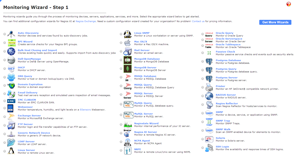
 Cacti :

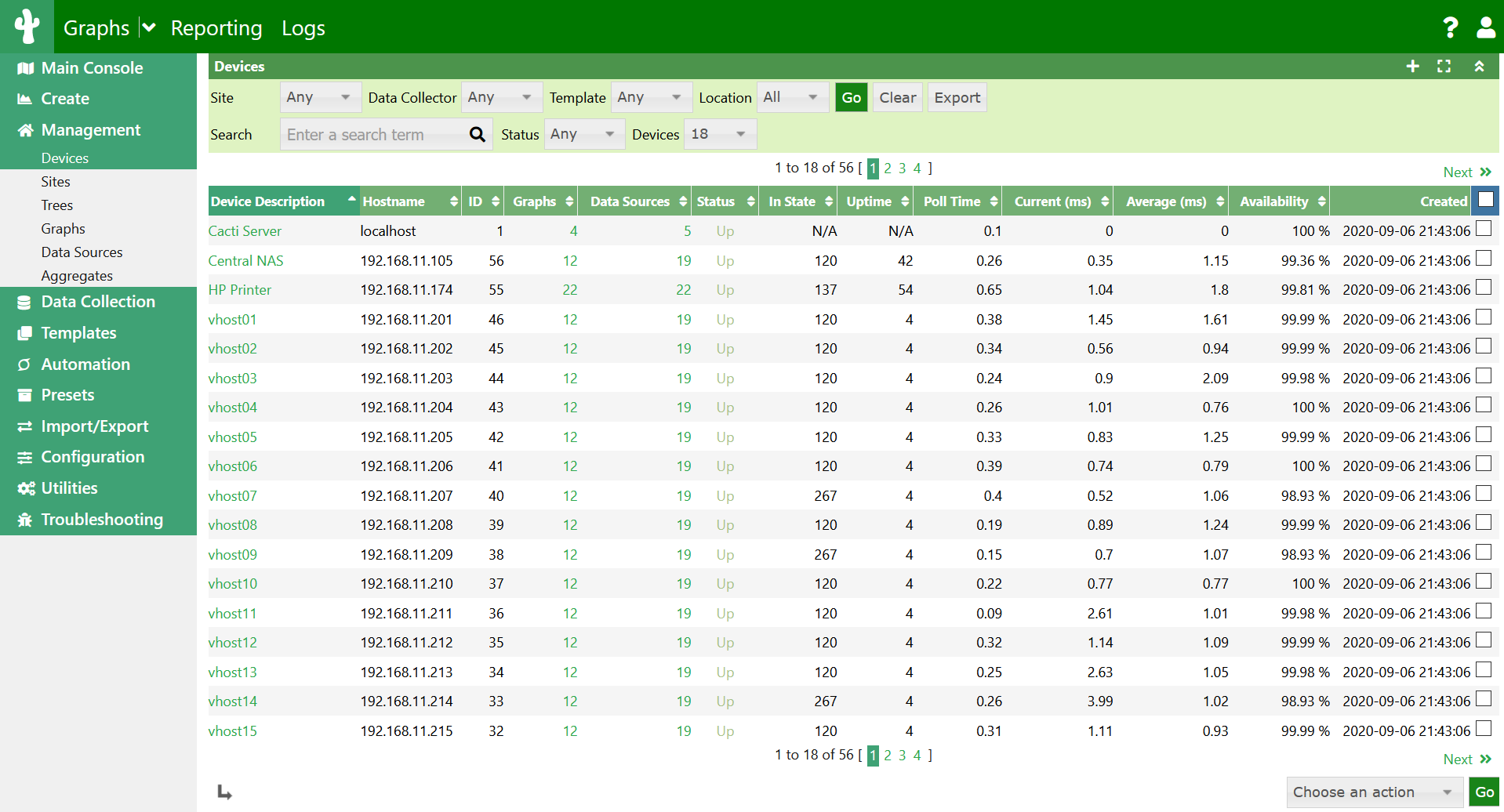
              is a complete network graphing solution designed to harness the power of RRDTool's data storage and graphing functionality. Cacti provides a fast poller, advanced graph templating, multiple data acquisition methods, and user management features out of the box. All of this is wrapped in an intuitive, easy to use interface that makes sense for LAN-sized installations up to complex networks with hundreds of devices.


               Cacti is a complete frontend to RRDTool. It stores all of the necessary information to create graphs and  populate them with data in a MySQL database. The frontend is completely PHP driven.


Download Link : http://www.cacti.net/download_cacti.php

or 

http://sourceforge.net/projects/cacti/

NeDi :

         is a lightwheight network management framework, which is based on a scheduled discovery, a SQL backend and a web based user interface.

         NeDi proofs to be a valuable tool for the security team as well. Keep track of wired and wireless clients throughout your entire network. You’ll be able to see IP changes and which hosts have more than one address. The upcoming host identification feature, expands NeDi’s awareness beyond the network layers and can locate vulnerable SSH servers for example…


Download Link : http://www.nedi.ch/download/

or

http://sourceforge.net/projects/nedi/?source=navbar

Observium :

                 is an autodiscovering PHP/MySQL based network monitoring system focused primarily on Cisco and Linux networks but includes support for a wide range of network hardware and operating systems.


                 Observium is an autodiscovering network monitoring platform supporting a wide range of hardware platforms and operating systems including Cisco, Windows, Linux, HP, Juniper, Dell, FreeBSD, Brocade, Netscaler, NetApp and many more. Observium seeks to provide a powerful yet simple and intuitive interface to the health and status of your network.
                 Observium Community is available free and open source. Observium Professional adds rapid patches, security fixes and additional features and hardware support for a small yearly license fee.


Download Link : http://observium.org/wiki/Download

or

http://sourceforge.net/projects/projectobserver/

ZABBIX :

                is an enterprise-class open source distributed monitoring solution designed to monitor and track performance and availability of network servers, devices and other IT resources. It supports distributed and WEB monitoring, auto-discovery, and more.

An enterprise-class distributed monitoring solution for networks & apps


Zabbix Features

  •     Monitor Everything
  •     Enterprise Ready
  •     Proactive Monitoring
  •     Capacity Planning
  •     True Open Source
  •     Business Solutions


Download Link : http://www.zabbix.com/download.php

or

http://sourceforge.net/projects/zabbix/
 

Monday, 6 January 2014

SpiderFoot 2.1.0 - Open Source Footprinting Tool

SpiderFoot:

                    simple web-based interface enables you to kick off a scan immediately after install - just give your scan a name, the domain name of your target and select which modules to enable.

                    You will quickly obtain information such as: URLs handling passwords, network ranges (netblocks), web servers, open ports, information about SSL certificates, and much more.


                       "Footprinting" is the process of understanding as much as possible about a given target in order to perform a more complete security penetration test. Particularly for large networks, this can be a daunting task.

                         The main objective of SpiderFoot is to automate this process to the greatest extent possible, freeing up a penetration tester's time to focus their efforts on the security testing itself.

                        SpiderFoot is designed from the ground-up to be modular. This means you can easily add your own modules that consume data from other modules to perform whatever task you desire.

                         As a simple example, you could create a module that automatically attempts to brute-force usernames and passwords any time a password-handling webpage is identified by the spidering module.


SpiderFoot 2.1.0 is now available, a major update over 2.0.5 which was released back in September.

Major improvements are as follows:

- Identifies sites co-hosted on IPs of your target.
- Checks whether your target, affiliates or co-hosts have a bad reputation (PhishTank, Google
SafeBrowsing, McAfee SiteAdvisor, abuse.ch and many more.)
- Identifies the ISPs and BGP AS of your target.
- Smarter at identifying owned netblocks.
- UI enhancements, including some data visualizations.
- More comprehensive searches across other Internet TLDs.
- Identifies the use of non-standard HTTP headers.
- Bing searches.
- Many tweaks, improvements and bug fixes.


Website & Download: http://www.spiderfoot.net
GitHub: https://github.com/smicallef/spiderfoot/tree/2.1
 Source Forge : http://sourceforge.net/projects/spiderfoot/


Friday, 3 January 2014

Arachni v0.4.6-0.4.3 (Open Source Web Application Security Scanner Framework)

Arachni v0.4.6-0.4.3 has been released :

                     (Open Source Web Application Security Scanner Framework)

                      There's a new version of Arachni, an Open Source, modular and
high-performance Web Application Security Scanner Framework written in Ruby.


Brief list of changes:

Framework
----------
* Massively decreased RAM consumption.
* Amount of performed requests cut down by 1/3 -- and thus 1/3 decrease in scan times.
* Overhauled timing attack and boolean/differential analysis algorithms to fix
  SQLi false-positives with misbehaving webapps/servers.
* Vulnerability coverage optimizations with 100% scores on WAVSEP's tests for:
  * SQL injection
  * Local File Inclusion
  * Remote File Inclusion
  * Non-DOM XSS -- DOM XSS not supported until Arachni v0.5.


WebUI
-----
* Implemented Scan Scheduler with support for recurring scans.
* Redesigned Issue table during the Scan progress screen, to group
  and filter issues by type and severity. 


Issues table

The issues table has been massively redesigned to provide more context at a glance and help you prioritize and focus on the issues that interest you most.


While the scan is running and new issues appear, High and Medium severity type groups will, by default, be displayed as expanded, to show each logged issue, while Low and Informational severity ones will be displayed as collapsed. This way your attention will be drawn to where it’s most needed.
Of course, you can change the visibility settings to suit your preferences, using the controls on the left of the table, as well as reset them to their default configuration.

Scan scheduling

The major change for the web interface is the addition of the much awaited Scheduler, which combined with the existing incremental/revisioned scans provides quite a powerful feature. In essence, it allows you to schedule a scan to run at a later time and optionally configure it to be a recurring one.


                                            What’s interesting here is the recurring bit, each scan occurrence is not a separate entity but a revision of the previous scan, this way you’ll be able to track changes in your website’s security with ease. It also allows you to speed things up by providing you with the ability to feed the sitemaps of previous revisions to the next one (either to extend or restrict the scope), thus making the crawl process much faster (or skipping it altogether).


 For more details about the new release please visit:
    http://www.arachni-scanner.com/blog/arachni-0-4-6-0-4-3-release/

Download page:               http://www.arachni-scanner.com/download/

Homepage                      - http://www.arachni-scanner.com
Blog                                 - http://www.arachni-scanner.com/blog
Documentation               - https://github.com/Arachni/arachni/wiki
Support                           - http://support.arachni-scanner.com
GitHub page                   - http://github.com/Arachni/arachni
Code Documentation     - http://rubydoc.info/github/Arachni/arachni
Copyright                        - 2010-2014
License                             - Apache License v2